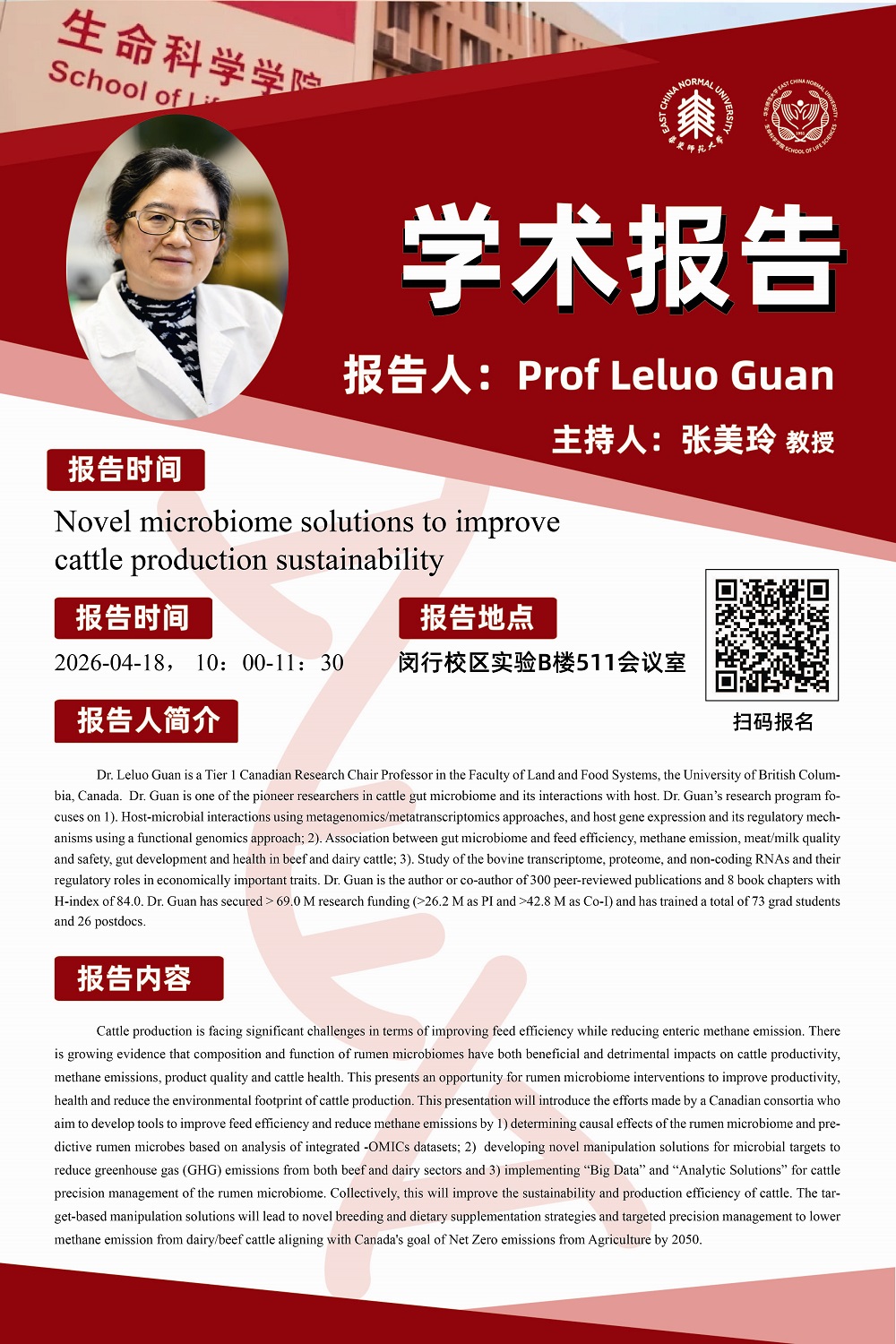
报告题目: Novel microbiome solutions to improve cattle production sustainability
报 告 人: Prof Leluo Guan
主持人/邀请人:张美玲 教授
报告时间:2026年4月18日, 10:00-11:30
报告地点:闵行校区实验B楼511会议室
报告人简介:
Dr. Leluo Guan is a Tier 1 Canadian Research Chair Professor in the Faculty of Land and Food Systems, the University of British Columbia, Canada. Dr. Guan is one of the pioneer researchers in cattle gut microbiome and its interactions with host. Dr. Guan’s research program focuses on 1). Host-microbial interactions using metagenomics/metatranscriptomics approaches, and host gene expression and its regulatory mechanisms using a functional genomics approach; 2). Association between gut microbiome and feed efficiency, methane emission, meat/milk quality and safety, gut development and health in beef and dairy cattle; 3). Study of the bovine transcriptome, proteome, and non-coding RNAs and their regulatory roles in economically important traits. Dr. Guan is the author or co-author of 300 peer-reviewed publications and 8 book chapters with H-index of 84.0. Dr. Guan has secured > 69.0 M research funding (>26.2 M as PI and >42.8 M as Co-I) and has trained a total of 73 grad students and 26 postdocs.
报告内容简介:
Cattle production is facing significant challenges in terms of improving feed efficiency while reducing enteric methane emission. There is growing evidence that composition and function of rumen microbiomes have both beneficial and detrimental impacts on cattle productivity, methane emissions, product quality and cattle health. This presents an opportunity for rumen microbiome interventions to improve productivity, health and reduce the environmental footprint of cattle production. This presentation will introduce the efforts made by a Canadian consortia who aim to develop tools to improve feed efficiency and reduce methane emissions by 1) determining causal effects of the rumen microbiome and predictive rumen microbes based on analysis of integrated -OMICs datasets; 2) developing novel manipulation solutions for microbial targets to reduce greenhouse gas (GHG) emissions from both beef and dairy sectors and 3) implementing “Big Data” and “Analytic Solutions” for cattle precision management of the rumen microbiome. Collectively, this will improve the sustainability and production efficiency of cattle. The target-based manipulation solutions will lead to novel breeding and dietary supplementation strategies and targeted precision management to lower methane emission from dairy/beef cattle aligning with Canada's goal of Net Zero emissions from Agriculture by 2050.